You defaulted on your student loans, and now a collections agency is calling about a lump-sum offer for less than you owe. Before you agree to anything, you need to know how student loan debt settlement actually works, because the rules here are very different from negotiating credit card debt. Federal loans and private loans play by separate playbooks, and getting the details wrong can cost you thousands or trigger a wage garnishment you thought you’d avoided.
Here’s the short answer: settlement almost always requires default first, typically 270 days of missed payments for federal loans, and settlements usually land between 40% and 85% of your balance depending on the type of loan and who owns the debt. Private lenders have far more room to negotiate than the federal government does, and that distinction changes your entire strategy.
This article walks through exactly who qualifies for debt settlement for student loans, what percentage payoffs you can realistically expect on federal versus private balances, and the step-by-step negotiation process, including what to say, what to get in writing, and where lump-sum settlements can backfire on your taxes or credit.
Why student loan debt settlement matters
Once you fall behind on student loans, the math turns against you fast. Interest keeps compounding, collection agencies tack on fees that can run 15% to 25% of your balance, and the federal government can garnish your wages, seize tax refunds, and even offset Social Security payments without a court order. That’s why understanding your settlement options isn’t optional homework, it’s the difference between paying a negotiated lump sum and watching your balance balloon for years while collectors chip away at your paycheck.
The cost of waiting
Delaying action almost always makes your situation worse, not better. A $20,000 federal loan in default can grow by thousands within a single year once collection costs and accrued interest stack up, and private lenders often sue for the full balance plus attorney fees if you ignore their calls. Settling early, before a lawsuit or wage garnishment order lands, typically gets you a better deal because collectors would rather recover 60 cents on the dollar today than fight you in court for years.
Every month you wait to negotiate is a month your leverage shrinks and your balance grows.
Who ends up considering settlement
Most people exploring student debt settlement share a few things in common. They’re usually already in default, meaning federal loans have gone 270 days or more without a payment, or private loans have hit whatever default trigger their servicer’s contract sets, often 90 to 120 days. They also tend to have little chance of paying the full balance even with a modified repayment plan, and they’ve decided that a partial payoff now beats a decade of garnishment or collection calls later.
- Borrowers who’ve already defaulted and been referred to a collection agency
- People facing an active wage garnishment or tax refund offset
- Anyone with private loans where the lender has stopped responding to standard repayment requests
- Borrowers who can gather a lump sum from savings, a family loan, or a settlement of other debts
Understanding where you fall on that list matters because it shapes which loans you should tackle first and how aggressively you can negotiate. If credit card balances are also part of your financial picture, our comparison of debt settlement versus debt consolidation can help you sequence which debts to settle before you approach your student loan servicer.
How settlement differs for federal vs. private loans
Federal and private student loans operate under completely different rules once you stop paying, and mixing up those rules is the fastest way to blow a negotiation. The U.S. Department of Education rarely accepts settlements below 85% of principal and accrued interest, and it almost never waives collection costs unless you’re negotiating through its Treasury Offset Program hardship process. Private lenders, by contrast, often sell defaulted debt to collection agencies for pennies on the dollar, giving those agencies far more flexibility to accept 40% to 60% settlements just to recover something.
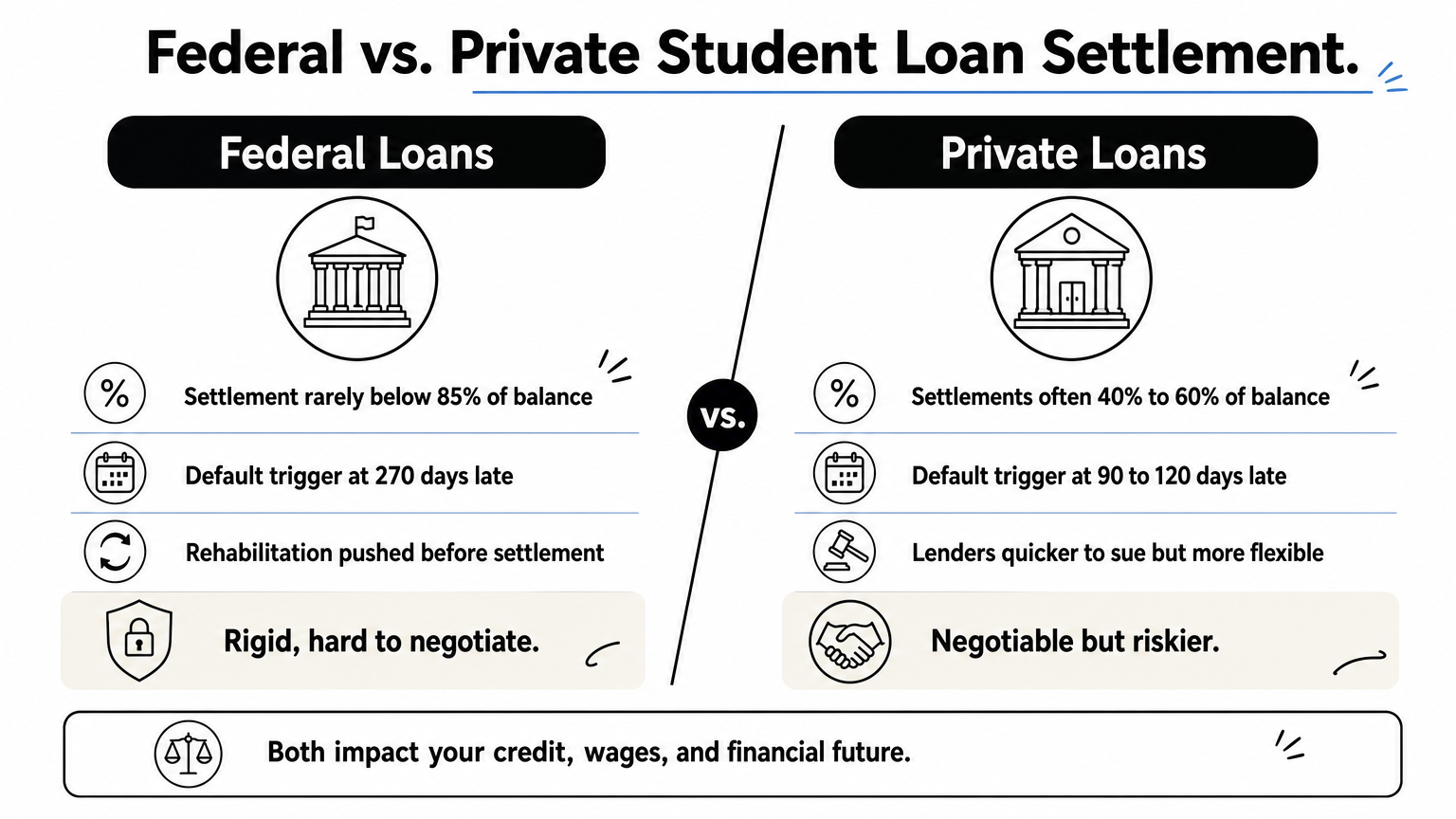
Federal loans rarely bend below 85 cents on the dollar; private debt can settle for less than half.
Federal loans: rigid but rehabilitatable
Rehabilitation and consolidating student loans exist specifically to keep federal borrowers out of settlement territory, so servicers push those options hard before entertaining a lump-sum offer. When settlement does happen, it’s usually tied to a documented financial hardship and requires paperwork proving you truly can’t repay through an income-driven plan.
Private loans: negotiable but riskier
Private lenders have no federal mandate to offer forbearance or income-driven repayment, so they’re often quicker to sue, which is worth knowing when you’re deciding whether you need a debt settlement lawyer, but that same lack of structure means more room to negotiate once a case looks weak or the statute of limitations is closing in.
| Loan Type | Typical Settlement Range | Default Trigger |
|---|---|---|
| Federal | 85%-90% of balance | 270 days late |
| Private | 40%-60% of balance | 90-120 days late |
How to negotiate a student loan settlement
Negotiating a student loan debt settlement is less about charm and more about paperwork and patience. Start by requesting a full account history from your servicer or collection agency, including the original principal, accrued interest, and any collection fees tacked on. You need this before you can judge whether an offer of, say, 55% actually saves you money or just shuffles the same debt around.
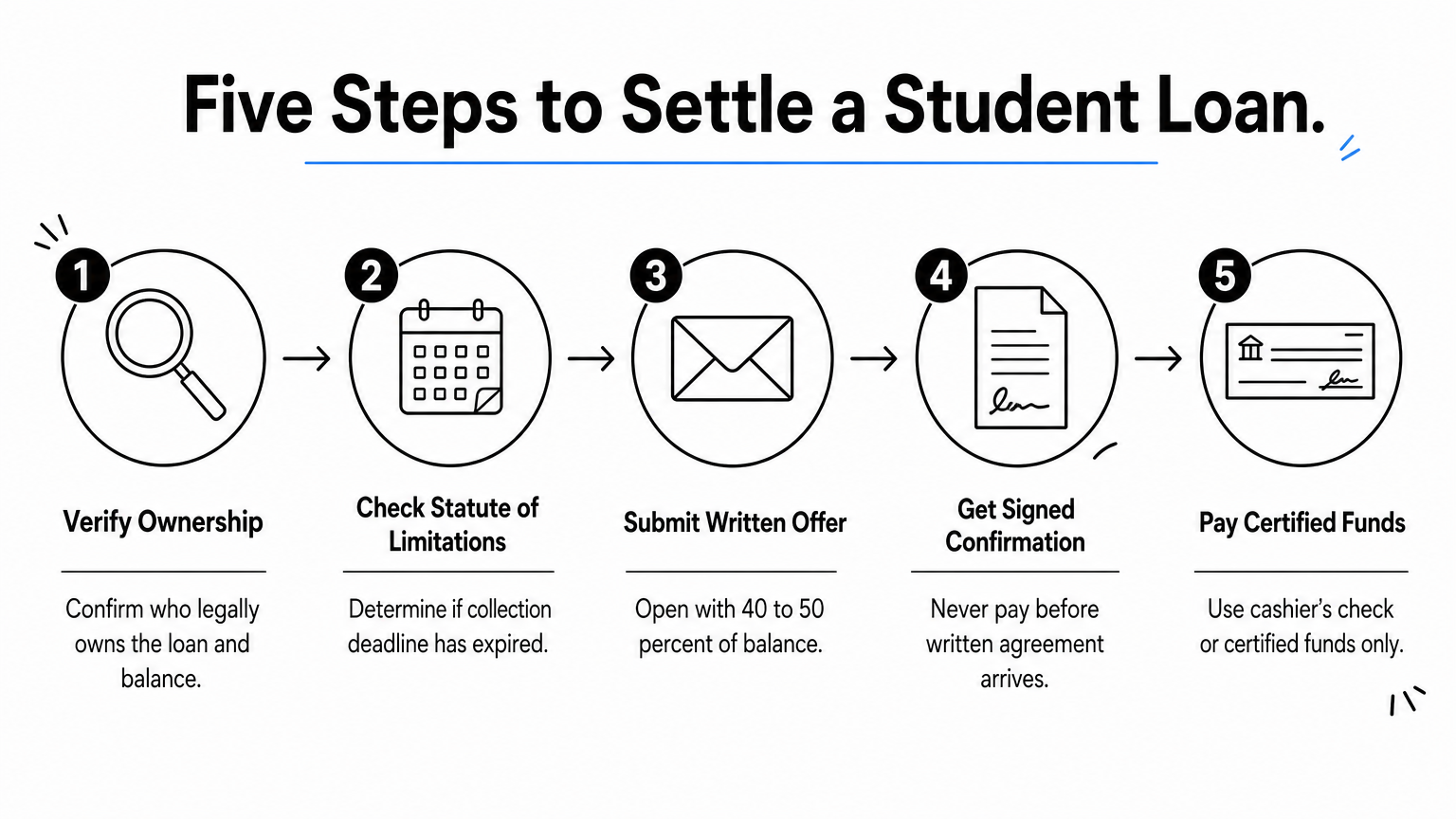
Verify the debt and your leverage
Before you say a number out loud, confirm who legally owns the loan and whether the statute of limitations on collection has expired in your state, since that single fact can shift negotiating power dramatically in your favor. Pull your credit report and credit score to see how the debt is listed, and ask the collector to send validation in writing rather than relying on a phone call.
Make your offer and get it in writing
Open low, usually 40% to 50% of the balance for private debt, and expect the agency to counter, the same back-and-forth you’d use when haggling with your creditors on any account. Never wire money or agree verbally; insist on a signed settlement letter before you pay anything.
Subject: Settlement Offer for Account [#XXXX]

I am prepared to pay a lump sum of $[amount] as full and final settlement of this account, contingent on written confirmation before payment and a report to credit bureaus as "settled in full."
Get the settlement terms in writing before a single dollar leaves your account.
Follow these steps in order:
- Verify ownership and balance
- Confirm the statute of limitations
- Submit a written offer
- Get signed confirmation
- Pay by cashier’s check or certified funds
What happens after you settle: taxes and credit impact
Settling a loan for less than you owe doesn’t make the difference disappear, it just changes who claims it. The IRS treats forgiven debt as taxable income in most cases, and your lender will send you a 1099-C form the following January reporting the canceled amount. Skip that form on your tax return and you’ll likely hear from the IRS within a year or two, with penalties added on top.
The tax bill on forgiven debt
According to the IRS guidance on canceled debt, if a lender forgives $8,000 on a settled loan, that $8,000 typically counts as ordinary income unless you qualify for an insolvency exclusion, meaning your liabilities exceeded your assets at the time of settlement. Insolvency requires documentation, so keep a snapshot of your finances the day the settlement closes, not months later when memories fade.

Forgiven debt isn’t free money, the IRS still wants its share unless you can prove insolvency.
Your credit report after settlement
Credit damage from debt settlement student loans cases lingers for years, since the account posts as "settled" rather than "paid in full," a status future lenders read as a red flag. Reporting stays on your file for roughly seven years from the original delinquency date, though the impact fades noticeably after the first eighteen to twenty-four months if you keep other accounts current and focus on rebuilding your score over time. Requesting a "paid as agreed" notation during negotiation, while rarely granted, costs nothing to ask for and occasionally works with smaller private collectors eager to close the file quickly.
Weighing your next move
Settling student loan debt can genuinely cut what you owe, but it’s not a free pass. You’ll trade a lower balance for a tax bill, a credit hit, and months of paperwork proving you can’t pay another way. Federal loans give you far less room to negotiate than private ones, so know which type you’re carrying before you make an offer or sign anything, and consider whether bankruptcy or debt settlement fits your situation better.
Before you call a collector, get your full account history, confirm the statute of limitations, and figure out whether rehabilitation or a settlement actually saves you more money over five years. Rushing a lump-sum deal to make the calls stop often costs more than waiting a few weeks to negotiate properly.
If credit card debt is stacked on top of your student loans, don’t tackle them in isolation. See how debt relief programs work and choose one that builds a payoff plan handling both at once.