You owe more than you can pay, and someone has told you a debt settlement negotiator can cut the balance by half. Maybe that’s true. Maybe you’d pay thousands in fees for a call you could have made yourself. Before you sign anything, you need to know what a negotiator actually does and what it costs you.
Here is the short answer. You can negotiate with creditors yourself for free, and many people do. A professional makes sense when you have several accounts in collections, face a lawsuit, or can’t handle the calls. Debt settlement companies typically charge 15% to 25% of the enrolled debt, and the process can wreck your credit score for years. A nonprofit counselor or an attorney is often a safer pick than a for-profit settlement firm.
This guide walks you through how settlement negotiation works, what to say on the phone, and what a fair offer looks like. You’ll also see how to spot scams, compare the costs of each route, and decide which one fits your situation. Then you can act with a plan instead of a sales pitch.
Who debt settlement negotiators are and what they do
A debt settlement negotiator is anyone who talks to your creditor or collector to get your balance accepted as paid in full for less than you owe. That can be a for-profit company, an attorney, or you. The goal is a lump-sum payoff well below the full balance, in exchange for the creditor closing the account.

How a settlement actually works
Creditors rarely discount a balance while you’re current. Most negotiators wait until accounts are 90 to 180 days past due, when the lender expects a loss and would rather take some cash than none. That is why settlement companies tell you to stop paying your cards and save into a dedicated account instead.
Late fees, interest, and collection calls keep piling up during that wait, and every missed payment lands on your credit report. A settled account is also reported as "settled for less than the full amount," which scores worse than "paid in full." On top of that, forgiven debt of $600 or more can be reported to the IRS on Form 1099-C and may count as taxable income.
A negotiator doesn’t erase your debt. They trade your credit score and your time for a smaller balance.
The four people who can negotiate for you
You have more options than the ads suggest. Here is how they compare.
| Who | What they do | Typical cost |
|---|---|---|
| For-profit settlement company | Holds your deposits in a savings account and negotiates once enough cash builds up | 15% to 25% of enrolled debt |
| Settlement attorney | Negotiates and defends you if a creditor sues | Hourly or flat fee |
| Nonprofit credit counselor | Usually sets up a debt management plan that cuts interest, not the balance | Small monthly fee |
| You | Call creditors or collectors directly | Free |
Federal rules protect you here. Under the FTC’s Telemarketing Sales Rule, a company selling debt relief by phone can’t charge you until it has settled a debt and you’ve made a payment on it. Any firm that demands upfront fees is a red flag, and the FTC’s guidance on debt relief scams lists other warning signs to watch for before you sign.
Step 1. Check the debt and your finances
Before you call debt settlement negotiators or a creditor, get your numbers straight. A settlement only works if you know exactly what you owe and how much cash you can put toward it. This step takes an afternoon and protects you from bad offers.
Build a debt inventory
Pull your free credit reports at AnnualCreditReport.com, then list every account in a spreadsheet. Collectors who bought your debt often show up as separate entries, so don’t skip them. Record these details for each one:
- Creditor or collector name, plus the original creditor
- Current balance and days past due
- Date of your last payment
- Any lawsuit or court notice you’ve received
Compare the last payment date to your state’s statute of limitations. In some states, a small payment on old debt can restart the clock, so don’t send money until you know where you stand.
Figure out your settlement budget
Next, count your cash. Creditors commonly accept 30% to 60% of the balance as a lump sum, depending on the age of the debt and who owns it. On a $10,000 card, that means having $3,000 to $6,000 ready. Add up your savings and what you can set aside each month for the next few months.
Never promise a lump sum you can’t produce, because a broken deal sends you back to square one.
Then check whether you’re insolvent, meaning your debts exceed your assets. If you are, you may be able to exclude forgiven debt from taxable income using IRS Form 982, as explained in IRS Topic 431. Ask a tax professional before you count on it.
Step 2. Decide whether to hire a negotiator
Your numbers from Step 1 point toward an answer. The decision turns on how many accounts you’re dealing with and how much legal risk you face.
Do it yourself when the case is simple
Most people with one to three accounts and a lump sum ready can handle the calls alone. You also keep the fee, which on $10,000 of enrolled debt runs $1,500 to $2,500. The calls feel uncomfortable, but they aren’t complicated.
Hire a professional when the risk is high
Consider paying for help if any of these apply:
- A creditor or collector has sued you, or you’ve received a summons
- Five or more accounts are in collections
- You can’t build a lump sum and need a structured plan
- The calls are hurting your job or your health
A debt settlement lawyer is the right call after a lawsuit, since only an attorney can defend you in court. If your income is steady, a nonprofit credit counselor may beat settlement, because a debt management plan avoids the credit damage.
Hire a professional for the legal risk or the volume of accounts, not for a phone call you can make yourself.
Vet any negotiator before you sign
Before you hand over a dime, get every fee in writing and confirm the firm charges nothing until it settles a debt. Then search your state attorney general’s site and the CFPB complaint database for the company’s name. Walk away from anyone who guarantees results.
Step 3. Negotiate the settlement yourself
Doing this yourself means doing what debt settlement negotiators do, minus the fee. Ask for the settlement or recovery department instead of the first agent who answers. Write down the date, the rep’s name, and what was said on every call.
Open with a short script
Start by saying you want to resolve the account and can pay a lump sum soon. Skip the life story. Hardship details only matter if the rep asks, and then stay brief and honest. Here is a script you can adapt:
"I'd like to resolve this account. I can pay a lump sum within
10 days if we agree on a settlement. I can offer $2,500, which
is 25% of the balance, as payment in full. Please send the
terms in writing before I send any money."
Counter in small steps
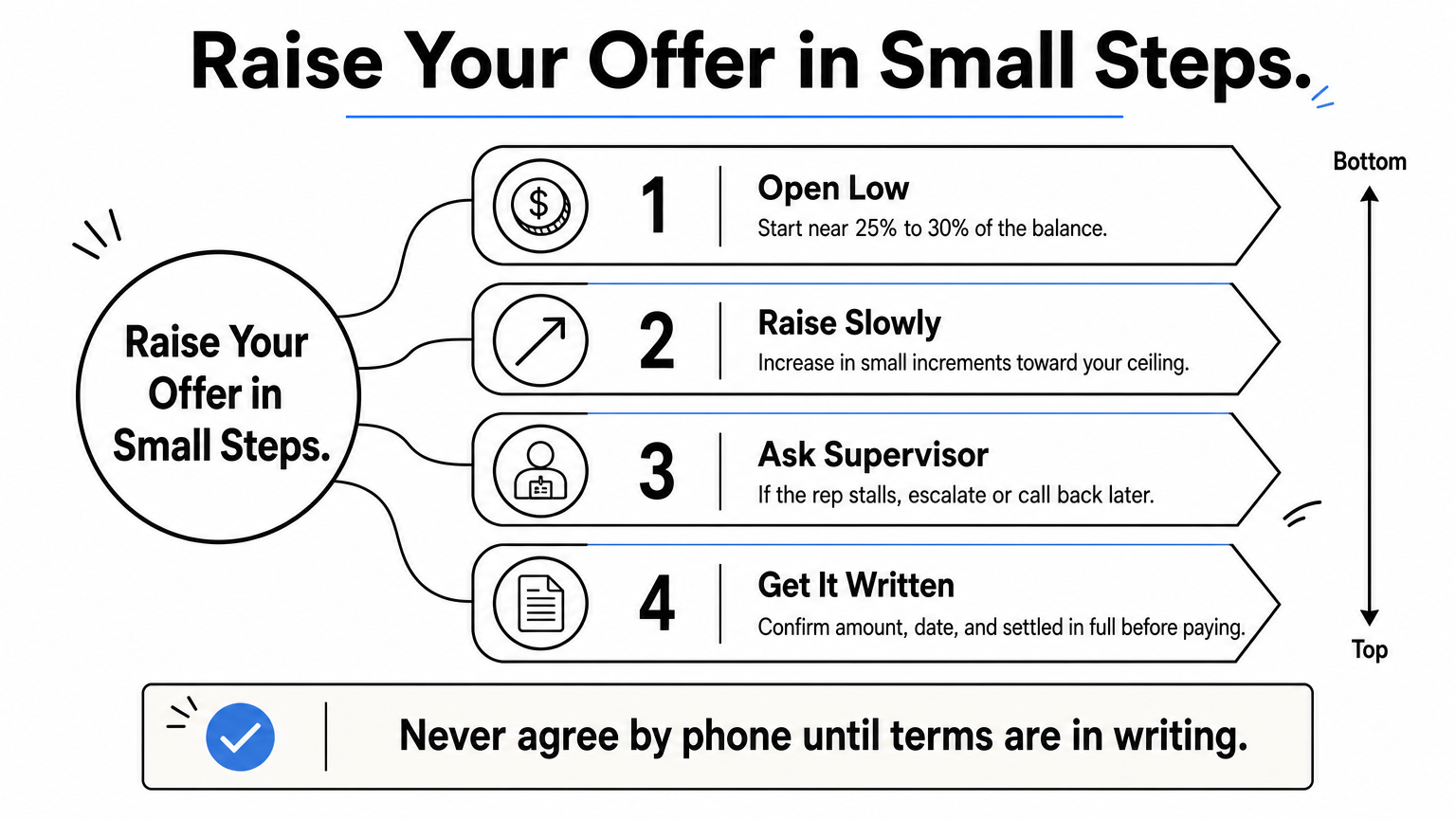
Expect a no on the first offer. Open near 25% to 30% of the balance, then raise it in small increments toward the ceiling you set in Step 1. Collectors who bought your debt for pennies on the dollar usually accept less than an original creditor. If the rep says they can’t go lower, ask for a supervisor or call back another day.
Never agree to anything on the phone until the terms are in writing.
Refuse to give bank account access or approve automatic debits. Once you have a written agreement that states the amount, the payment date, and that the account will be settled in full, pay by cashier’s check or a one-time payment you control.
Step 4. Lock in the deal and handle the fallout
Agreeing on a number is not the finish line. Whether you hired one of the debt settlement negotiators or went solo, the deal only counts once it’s on paper, and the aftermath needs attention too.

Get the agreement in writing
Before you send a dollar, require a written letter from the creditor or collector. It should include:
- The creditor name and your account number
- The exact settlement amount and the payment deadline
- A statement that the payment satisfies the debt in full
- A promise to report the account accurately to the credit bureaus
After you pay, keep every receipt and letter for at least seven years. Collectors sometimes lose records or resell accounts, and your paperwork is the only defense.
A settlement isn’t finished until you hold written proof that the balance is zero.
Handle the credit and tax fallout
Wait 30 to 60 days, then pull your credit reports again. The account should show a zero balance and a status of settled. If it doesn’t, dispute it in writing and attach your settlement letter.
Expect a Form 1099-C in January if the forgiven amount tops $600. Report it correctly, and file Form 982 if you were insolvent, as covered in Step 1. Then rebuild with a secured card and on-time payments, because a settled account can drag your score for up to seven years. Your new habits will matter more than that one entry.
Choosing the right path for your debt
The choice between hiring debt settlement negotiators and doing it yourself comes down to risk and volume. If you have a few accounts and a lump sum ready, you can negotiate on your own and keep the fees. If you face a lawsuit or a pile of collection accounts, an attorney or a vetted professional earns their price.
Whichever route you take, the rules stay the same. Check your numbers first, get every term in writing, and plan for the credit and tax fallout. Settlement trades your score for a smaller balance, so make sure that trade fits your goals.
Ready to compare your options side by side? Read the guides on balance transfers, consolidation loans, and debt management plans in the Credit Card Solution debt relief programs library, then pick the strategy that fits your credit score and your budget.