The debt relief programs Ohio residents can use come down to six real options: a nonprofit debt management plan, a card issuer hardship program, a consolidation loan, a balance transfer card, debt settlement, and bankruptcy. A good pick fits your credit score and income, costs little upfront, and comes from a provider you can verify. Steady income with fair or poor credit points to a debt management plan. A score of about 670 or higher points to a loan or transfer card. Income that has collapsed points to settlement or bankruptcy.
The problem is that card rates of 18% to 29% make minimum payments barely touch the balance. Search results for "debt relief" are full of ads for companies that charge heavy fees. Ohio has no official government program that erases credit card debt, so you have to sort the legitimate options from the marketing yourself.
This article walks through the six options from lowest risk to highest. Each one gets the same breakdown: how it works, who it fits, and what it costs. Then you get a table to match an option to your situation, and a checklist to verify any provider before you hand over a dollar. Credit Card Solution is an ad-funded education site, so we do not enroll you in anything.
1. Nonprofit debt management plan
A debt management plan (DMP) is the strongest first option for most Ohioans with credit card debt and steady income. A nonprofit credit counseling agency negotiates lower interest rates with your card issuers, and you make one monthly payment to the agency.

A DMP lowers your interest without requiring good credit, which is why it is the default recommendation for most people with card debt and a paycheck.
How it works
You start with a free counseling session. The counselor reviews your income, expenses, and debts, then asks your issuers to cut interest and waive some fees. Rates on enrolled cards often drop into the single digits, commonly around 8%. You send one fixed payment to the agency each month, and it distributes the money to your creditors. Most plans run three to five years.
A DMP covers unsecured debt such as credit cards, medical bills, and some personal loans. It does not cover a mortgage or car loan. The Ohio Attorney General tells consumers to look for a nonprofit credit counseling service through the National Foundation for Credit Counseling (nfcc.org or 800-388-2227).
Who it fits
A DMP suits you if your balances carry high interest and your income is steady enough to commit to a fixed payment for years. Your credit score is not a factor for enrolling, so it works when a loan or transfer card is out of reach. It is a poor fit if your income is unstable or your debt is so large you could not finish in five years.
Costs and risks
Expect a small setup fee and a monthly fee, so ask for both in writing before you sign. The tradeoffs:
- Enrolled cards are usually closed, which can dip your score at first.
- A missed payment can cancel your rate concessions, and rates can return to 20% or more.
- You must stop using the enrolled cards.
2. Card issuer hardship program
Calling your card issuer is the cheapest of the six options, and it costs nothing but time. Most large issuers run hardship programs for customers hit by job loss, illness, or reduced hours.
Ask your issuer for a hardship plan before you pay anyone else, because the free option should be the first one you try.
How it works
Call the number on the back of your card and ask for the hardship or financial assistance department. Depending on the issuer, you may get a lower interest rate, waived late fees, or a reduced minimum payment for a set period, usually several months. Before you call, prepare:
- A one-page budget showing income and essential expenses.
- A clear reason for the hardship and how long you expect it to last.
- The payment you can realistically afford.
Who it fits
This works for a temporary setback when you have one or two cards and expect your income to recover. It is a weak fit when you owe thousands across five or six cards, because you would have to negotiate with each issuer separately and the relief is short-lived.
Costs and risks
Hardship plans are free, but terms vary by issuer and nothing is guaranteed. The card is often frozen or closed, and the account may be noted on your credit report. Rates usually return to normal when the plan ends, so use the breathing room to pay down principal. Get every term in writing.
3. Debt consolidation loan
A consolidation loan replaces several card payments with one fixed payment at a lower rate. It only saves money when the loan’s APR is meaningfully below what your cards charge.

A consolidation loan changes your payment, not your debt, so it only works if you stop running the cards back up.
How it works
You borrow enough to pay off your cards, then repay the loan over a fixed term, typically one to five years. Banks, credit unions, and online lenders all offer these loans. Ohio credit unions are worth checking because they often price personal loans below big online lenders. Use a prequalification tool first, since it uses a soft credit check and does not hurt your score.
Who it fits
This suits you if your score is around 670 or higher, your income is steady, and you can stop using the cards. At that level you can often qualify for a rate well below a typical 25% card APR. If your score is poor, the offered rate may be no better than your current cards, and a DMP will usually serve you better.
Costs and risks
Compare the full APR, not just the monthly payment. Some lenders charge an origination fee, often a few percent of the loan, which comes out of the proceeds. Applying adds a hard inquiry. The biggest risk is behavioral: if your cards fill up again, you carry the loan plus new balances. A secured loan also puts your car or home at risk to repay what was unsecured debt.
4. Balance transfer credit card
A balance transfer card moves your debt to a 0% introductory APR, so every payment goes to principal. It is the cheapest option if you can pay off the balance before the promotion ends.
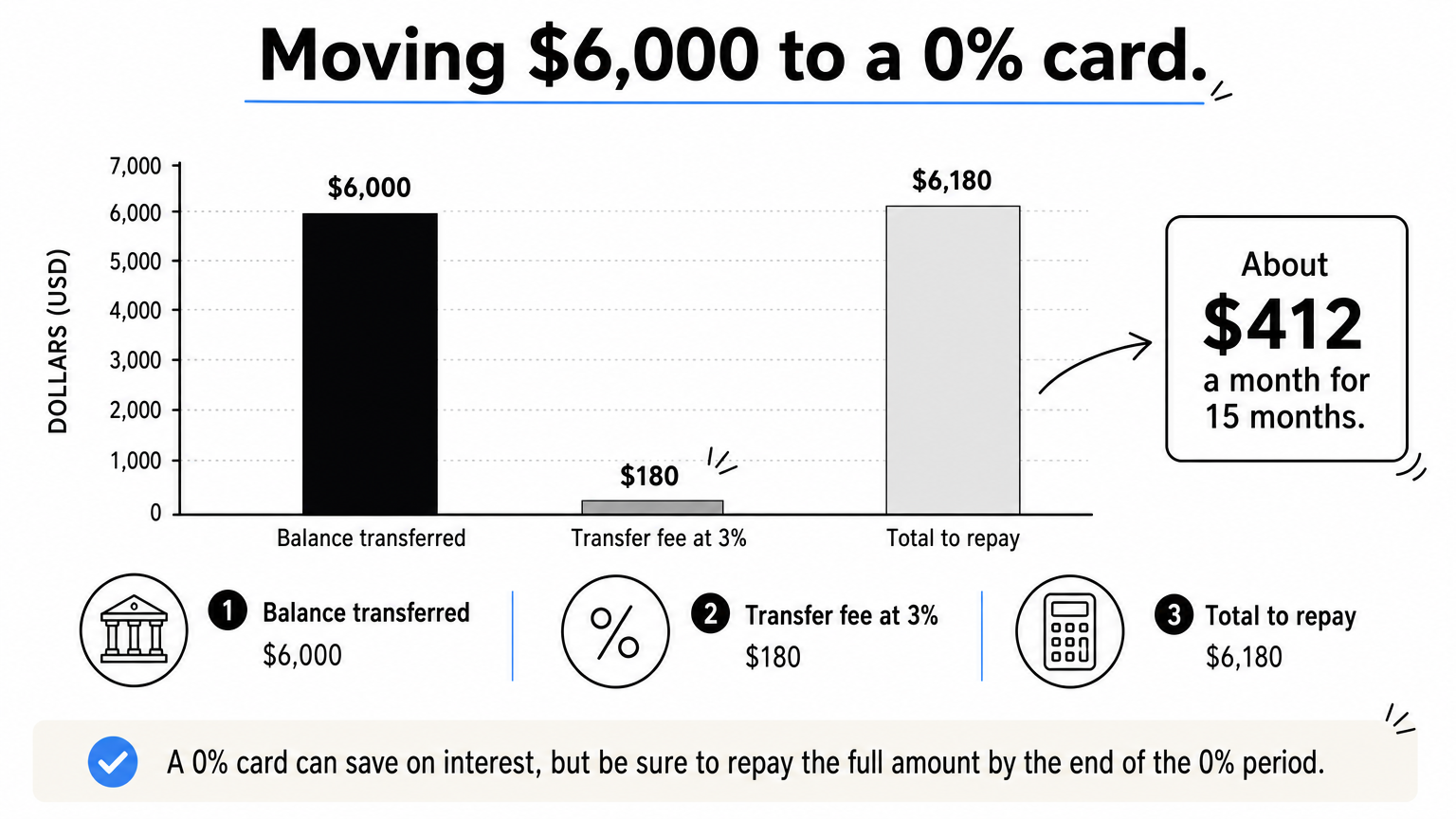
A 0% card is a deadline, not a discount, so divide the balance by the promo months before you apply.
How it works
You apply for a card with a 0% intro APR, commonly lasting 12 to 21 months, then transfer your balances onto it. Issuers typically charge a transfer fee of 3% to 5%. Here is a worked example for a $6,000 balance:
| Item | Amount |
|---|---|
| Balance transferred | $6,000 |
| Fee at 3% | $180 |
| Total to repay | $6,180 |
| Payment to clear in 15 months | about $412 a month |
Who it fits
The best offers go to people with good to excellent credit, usually 670 or higher. It suits moderate balances you can clear within the promo window. It is a poor fit if you can only afford small payments, because the leftover balance reverts to the card’s regular rate, which is often high.
Costs and risks
Your new credit limit may be lower than your total debt, so you may only move part of it. A late payment can end the 0% rate early. New purchases may not qualify for the promotional rate. Opening the card adds a hard inquiry, and the strategy fails if you keep spending on the old cards.
5. Debt settlement
Debt settlement means paying creditors less than you owe, and it is the riskiest option that is not a court process. Treat it as a last step before bankruptcy, not a first move.
Settlement can cut what you owe, but it works by damaging your credit first, so it is for people who are already past the point of paying in full.
How it works
In a typical for-profit program, you stop paying your cards and deposit money into a dedicated account each month. When the account is large enough, the company offers each creditor a lump sum, often after 24 to 48 months. You can also negotiate directly with a creditor on an account already delinquent. A few nonprofit agencies offer structured, settlement-style programs, but availability is limited, so confirm the terms in writing.
Settlement does not work for government-backed student loans, mortgages, car loans, or child support.
Who it fits
It fits you only if you owe a large amount of unsecured debt, a hardship has made full repayment unrealistic, and a DMP would not fit your income. If the alternative is bankruptcy, it deserves a look.
Costs and risks
Know exactly what you are signing up for:
- Fees are often 15% to 25% of enrolled debt. Under federal rules, a settlement company cannot charge a fee before it settles at least one of your debts.
- Late fees, interest, collection calls, and even lawsuits can pile up while you stop paying.
- Negative marks can stay on your credit report for up to seven years.
- Forgiven debt of $600 or more may be reported to the IRS and counted as taxable income.
- Creditors are not obligated to accept any offer.
6. Chapter 7 or Chapter 13 bankruptcy
Bankruptcy is the final option when your debt is more than you can repay in about five years. It is expensive for your credit, but it is the only option with a legal shield against collectors.
Bankruptcy is a legal reset, not a failure, and the right Ohio attorney can tell you in one consultation whether you are close to needing it.
How it works
You file a petition in the federal bankruptcy court that covers your Ohio county, either the Northern or Southern District. An automatic stay halts most collection actions as soon as you file. Chapter 7 discharges most unsecured debts, usually in three to six months, though a trustee may sell non-exempt assets. Chapter 13 sets up a three to five year repayment plan that lets you keep your property. Ohio has its own list of exempt property, so an attorney should check what you can keep. Before filing, you must complete credit counseling from an approved agency.
Who it fits
Chapter 7 is for people with low income who pass the means test, which compares your income to the Ohio median for your household size. Chapter 13 is for people with steady income who want to keep a home or catch up on a mortgage while repaying part of their debts. Hire an Ohio bankruptcy attorney, and ask about free first consultations.
Costs and risks
Your credit score can drop 100 to 200 points. Chapter 7 can stay on your report up to 10 years, and Chapter 13 up to seven. Court filing fees run a few hundred dollars, plus attorney fees. Many debts survive bankruptcy: most student loans, child support, alimony, and often recent tax debt.
How to choose the right program for you
Choose by credit score and income first, then by how much you owe relative to what you can repay in five years. The table below turns that into a starting point.
Your credit score picks the cheap options, your income picks the realistic ones, and the cheapest option you can finish is the right one.
Match the option to your situation
| Your situation | Look first at | Why |
|---|---|---|
| Score 670+, balance you can clear in 12 to 21 months | Balance transfer card | 0% interest while you pay |
| Score 670+, larger balance, need 3 to 5 years | Consolidation loan | One fixed payment, lower rate |
| Fair or poor credit, steady income | Debt management plan | No score requirement, lower rates |
| Temporary setback, one or two cards | Hardship program | Free and fast |
| Income gone, debt too big to repay in 5 years | Settlement or bankruptcy | Talk to an attorney first |
A worked example on $10,000
Say you owe $10,000 at 25% APR. That costs about $208 a month in interest alone. A DMP that cuts the rate to about 8% drops monthly interest to roughly $67. Repaying over five years at 8% takes about $203 a month, or roughly $12,170 total before agency fees. On the original card, paying that same $203 would not even cover the $208 of monthly interest, so the balance would grow.
So is a program worth it? It is when the total you will pay (principal, interest, and fees) is lower than what you would pay on your own, and you can realistically finish it. If you cannot finish, a program is not a bargain.
How to spot a legitimate program in Ohio
A legitimate program is transparent about fees, puts terms in writing, and never promises results it cannot control. Most scams fail at least one of those tests.
If a provider charges before it delivers, guarantees an outcome, or tells you to stop paying without explaining the damage, walk away.
There is no government program for card debt
Ohio has no official government program that wipes out credit card debt, and neither does the federal government. Federal relief programs exist for certain student loans, but that is a separate issue. Any ad using "government-approved" language for card debt is marketing, not an official program.
Green flags and red flags
Look for these signs before you enroll:
- Good: nonprofit status you can verify through the NFCC, a free first session, and written fee schedules.
- Good: a counselor who reviews your whole budget before recommending anything.
- Bad: upfront fees for settlement, which federal rules prohibit.
- Bad: guaranteed results, "limited-time" pressure, or a refusal to put terms in writing.
You can also review the Ohio Attorney General’s consumer tips on credit repair, and file a complaint there if a business misleads you.
Your rights with Ohio collectors
The federal Fair Debt Collection Practices Act and the Ohio Consumer Sales Practices Act protect you. A collector must send a written notice within five days of first contact stating the amount, the creditor, and your right to dispute. Under federal rules, a collector generally cannot call you more than seven times in seven days about one debt. For most consumer debts, Ohio’s statute of limitations is six years, but a payment can restart the clock, so check before paying an old debt.
Where to go from here
Start with the free options: call your issuer about a hardship plan, then book a session with a nonprofit credit counselor. If your credit is strong, price out a balance transfer card or consolidation loan. If your debt is beyond five years of repayment, talk to an Ohio bankruptcy attorney before you consider settlement. In every case, check the provider’s credentials, get fees in writing, and never pay for a promise.
The cheapest option you can actually finish is the right one. For more step-by-step guidance on how to get out of credit card debt, browse the guides at Credit Card Solution.