You’re paying 22% or more on a credit card balance, and every payment feels like it barely moves the needle. That’s because it doesn’t. On a $6,000 balance at 24% APR, minimum payments can leave you paying interest for over a decade, which is why so many people look for ways to get out of credit card debt fast. If you want to transfer credit card balance 0 interest offers instead, you’re already thinking about this the right way.
The cards below all offer a genuine 0% introductory APR period on balance transfers, ranging from 12 to 21 months, giving you real time to attack principal instead of feeding interest charges, much like the broader field of credit cards offering 0% APR. Some come with no annual fee, others have stronger rewards once the promo period ends, and a few work better depending on whether your credit score is excellent or just good. What matters most is matching the offer to your payoff timeline, not just chasing the longest promo window.
Below, you’ll find a ranked list of the strongest 0% APR balance transfer credit cards available right now, along with the transfer fees, promo lengths, and credit score requirements you should weigh when comparing the top cards for balance transfers. We’ll also walk through how to calculate whether a transfer actually saves you money once fees are factored in, so you can pick the card that gets you out of debt fastest, not just the one with the flashiest headline.
1. Wells Fargo Reflect Card
The Wells Fargo Reflect Card sits at the top of this list for one simple reason: it offers the longest 0% intro APR window of any mainstream balance transfer card on the market. If you’re carrying a large balance and need every extra month you can get, this card gives you more runway than almost anything else out there.

Intro APR period and how long you get
Wells Fargo starts you off with 18 months at 0% APR on balance transfers, but if you make your minimum payments on time during that period, you can stretch it to 21 months total. That’s nearly two full years of interest-free payments, which is enormous when you’re working through a five-figure balance. Miss a payment, though, and you lose the extension, so set up autopay the day your card arrives.
Twenty-one months at 0% interest turns a debt you’d carry for years into one you can actually finish.
Balance transfer fee
You’ll pay either 5% or $5, whichever is greater, on transfers made within the first 120 days of account opening. On a $6,000 balance, that’s a $300 fee upfront. It’s higher than some competitors, but the tradeoff is the extra months of 0% APR, which usually saves far more in interest than the fee costs, especially on larger balances.
Ongoing APR after the intro period
Once the promotional window closes, the variable APR jumps to 17.24% to 28.99%, depending on your creditworthiness at approval. This is a standard range for cards in this category, but it’s still a steep number. The entire point of this card is to have your balance paid off, or close to it, before that rate kicks in. If you’re not confident you can clear the debt within 21 months, learn how to pay off credit card debt fast and build a payment plan now rather than waiting until month 18 to figure out the math.
Rewards and long-term value
This card doesn’t offer cash back or points, and that’s by design. Wells Fargo built the Reflect Card specifically as a debt payoff tool, not a spending card, which puts it squarely among the cards designed for paying off debt. There’s no annual fee, no rewards program to track, and no incentive to keep swiping after your balance is cleared. For someone using this card purely to transfer credit card balance 0 interest and knock it out, the lack of rewards is a feature, not a drawback. It keeps your focus where it belongs.
Who it’s best for
The Reflect Card fits best if you meet a specific profile:
- You have a balance of $4,000 or more that would take longer than 15 months to pay off on a shorter promo card
- Your credit score is in the good to excellent range (670+), since approval odds drop below that
- You’re disciplined enough to set up autopay and avoid missing the extension requirement
- You don’t need rewards and want a card solely for debt payoff, not everyday spending
- You can commit to a realistic monthly payment plan that clears the balance before month 21
If your balance is smaller, say under $3,000, a shorter promo card with a lower transfer fee might actually save you more money overall. But for larger balances where time matters most, the Reflect Card’s extended runway is hard to beat. For a broader breakdown of how balance transfers stack up against other payoff strategies, check out our tips on debt consolidation.
2. Citi Diamond Preferred Card
The Citi Diamond Preferred Card trades a bit of length for one of the lowest transfer fees you’ll find on a long-term 0% offer. It’s a strong pick if you want a solid promo window without the higher fee structure some competitors charge.
Intro APR period and how long you get
Citi gives you 0% APR for 21 months on balance transfers, matching the longer end of what’s available in this category. Purchases also get a 12-month 0% window, which is a nice bonus if you need to make a large purchase while paying down existing debt. Almost two years of interest-free payments gives you room to build a realistic payoff schedule instead of scrambling.
A 21-month runway with a low transfer fee often beats a longer promo that costs more upfront.
Balance transfer fee
Transfers completed within the first four months carry a fee of 5% or $5, whichever is greater. That’s the same structure as many competitors, but Citi’s pricing tends to run competitively when you compare total cost across a five-figure balance. Always run the math on your specific balance before committing.
Ongoing APR after the intro period
After the promotional period ends, the variable APR settles between 18.24% and 28.99%, based on your credit profile at approval. That’s a wide range, so your actual rate depends heavily on your score and income at the time you apply. As with every card on this list, the goal is to have your balance gone before this rate ever applies to you.
Rewards and long-term value
This card doesn’t offer cash back or points, keeping the focus squarely on debt payoff. There’s no annual fee, which matters over 21 months of carrying a card you’re not using for daily spending. If you want a card that stays out of your way while you knock down a balance, this simplicity works in your favor.
Who it’s best for
The Diamond Preferred Card suits readers with good to excellent credit (670+) who want a long payoff window paired with a manageable fee. It’s especially useful if you’re also planning a near-term large purchase alongside your transfer credit balance to 0 interest strategy, since the purchase APR offer adds flexibility most competitors skip.
3. Citi Simplicity Card
The Citi Simplicity Card is built around one idea: no late fees, ever, and no penalty APR if you slip up, and a closer look at the Citi Simplicity and Citi Double Cash cards shows how differently the two are built. For readers who’ve been burned by a single missed payment wrecking their promo rate on another card, this one removes that risk entirely.
Intro APR period and how long you get
Citi offers 0% APR for 21 months on balance transfers, tying it with the Diamond Preferred for one of the longest windows available. You also get 12 months of 0% APR on new purchases, though piling on new spending while you’re trying to pay off a transferred balance usually works against you. Nearly two years without interest gives you a genuine shot at clearing a large balance without feeling rushed.
Balance transfer fee
Transfers made within the first four months carry a fee of 5% or $5, whichever is greater, matching the standard structure you’ll see across most cards on this list. On a $7,000 transfer, that’s $350 upfront, a cost you should weigh against how much interest you’re actually escaping. Run the math before you commit, especially if your current APR is only moderately high.
Ongoing APR after the intro period
After month 21, the variable APR moves to 18.24% and 28.99%, depending on your credit standing at approval. Unlike most cards, though, Citi won’t hit you with a penalty rate if you’re late on a payment. That said, missing payments can still cost you the promotional rate entirely, so don’t treat this as a free pass to skip due dates.
No penalty APR means one late payment won’t wreck the deal you signed up for.
Rewards and long-term value
Simplicity lives up to its name here. There’s no cash back, no points, and no annual fee, which keeps your attention on paying down debt rather than chasing rewards categories. This stripped-down approach suits anyone who wants a 0 APR for balance transfer card without extra complexity cluttering the decision.
Who it’s best for
This card fits readers with good to excellent credit who want a long 0% window and extra protection against fee-related setbacks. If you’ve missed payments in the past on other accounts, the no-penalty-APR structure makes this a safer choice than most alternatives on this list.
4. BankAmericard Credit Card
The BankAmericard Credit Card keeps things refreshingly simple: no rewards, no annual fee, and one of the lowest transfer fees you’ll find on a card offering a full 18 months at 0%. If you just want a straightforward tool to transfer balance credit card 0 interest without extra bells and whistles, this card gets the job done without overcomplicating the decision.
Intro APR period and how long you get
BankAmericard gives you 0% APR for 18 billing cycles on both balance transfers and new purchases, which works out to roughly a year and a half of interest-free payments. That’s shorter than the Wells Fargo Reflect or Citi’s 21-month offers, but it’s still plenty of runway for most balances under $8,000 if you commit to a firm monthly payment.
Balance transfer fee
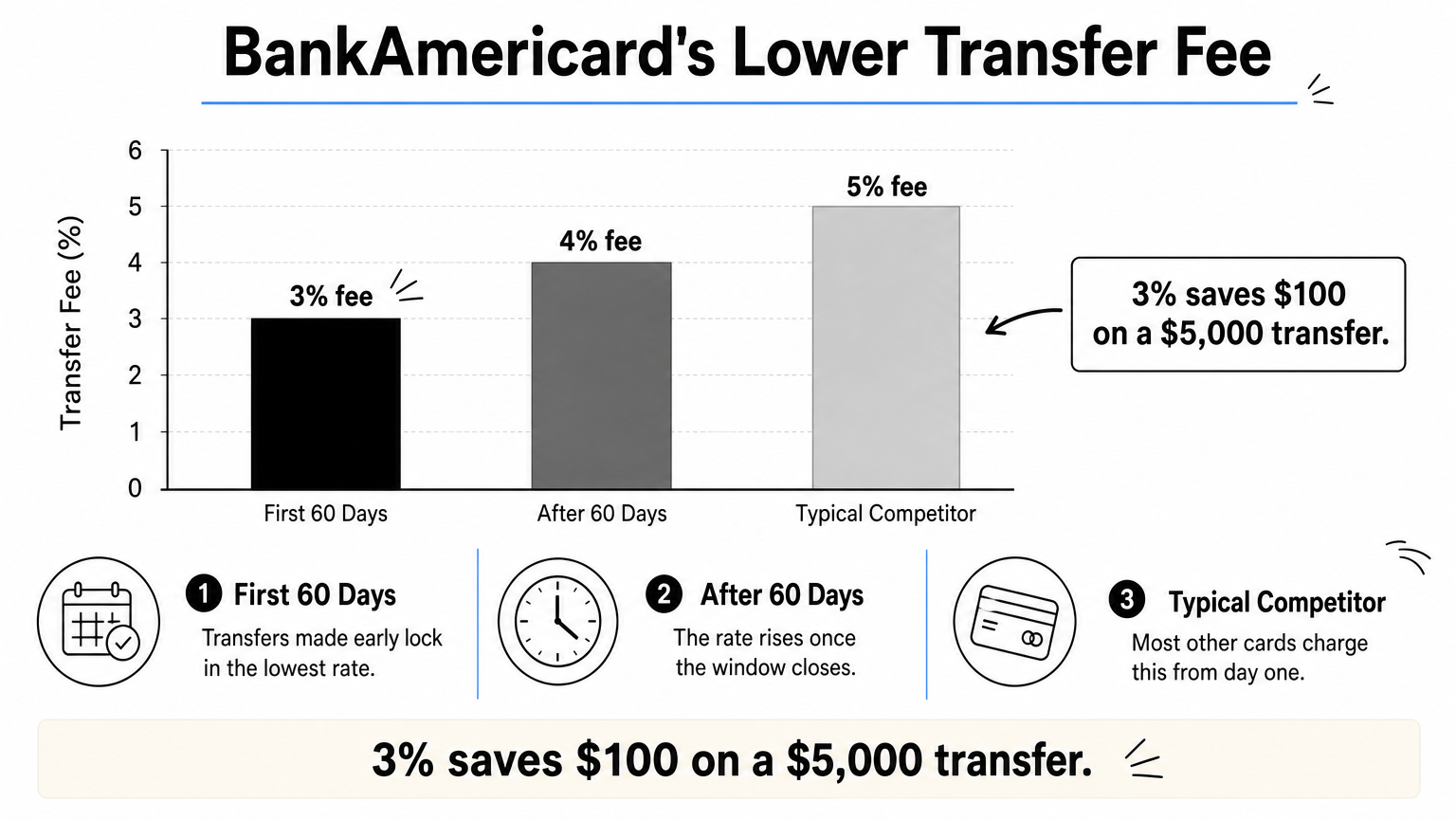
Here’s where this card stands out: transfers made in the first 60 days carry a 3% fee ($10 minimum), then it rises to 4% afterward. That intro rate is noticeably lower than the 5% most competitors charge across the board. On a $5,000 transfer completed early, you’d pay $150 instead of $250, a real savings if you move fast after approval.
A lower transfer fee window rewards readers who act quickly instead of sitting on an approved offer.
Ongoing APR after the intro period
Once the 18 cycles end, the variable APR settles between 16.24% and 26.24%, based on your creditworthiness. This range sits slightly lower than several other cards on this list, which matters if you end up carrying a small remaining balance past the promo window through no fault of planning.
Rewards and long-term value
This card offers no cash back, no points, and no sign-up bonus. Bank of America built it purely as a 0 apr credit card balance transfer option, not a spending card, so there’s nothing pulling your attention away from debt payoff while the clock runs.
Who it’s best for
Readers with good credit (usually 670+) carrying a moderate balance benefit most here, especially those who can transfer within the first 60 days to lock in the lower 3% fee, so it pays to improve your credit score before applying. It suits anyone prioritizing a cheaper transfer cost over the longest possible promo window.
5. U.S. Bank Shield Visa Card
The U.S. Bank Shield Visa Card pairs a lengthy 0% window with a built-in perk that most balance transfer cards skip entirely: cell phone protection. If you want a long payoff runway plus a bit of everyday value once your balance is cleared, this card earns its spot on the list.
Intro APR period and how long you get
U.S. Bank sets you up with 0% APR for 21 billing cycles on balance transfers, putting it right alongside Citi’s longest offers. That’s roughly 21 months of interest-free payments, giving you enough time to structure a payoff plan around even a stubborn five-figure balance without rushing the math.
Balance transfer fee
Transfers made within the first 60 days carry an introductory fee of 3% (minimum $5), then the standard rate climbs to 5% afterward. Acting quickly after approval saves real money here. On a $6,000 transfer, that’s a $180 fee inside the window versus $300 once it closes, so don’t let an approved offer sit unused.
Moving fast after approval can cut your transfer fee nearly in half.
Ongoing APR after the intro period
When the promotional period ends, the variable APR runs between 20.24% and 28.24%, depending on your credit profile at approval. That’s on the higher end compared to some cards on this list, which makes clearing your balance before month 21 even more important with this particular offer.
Rewards and long-term value
While there’s no cash back or points program, U.S. Bank includes cell phone protection when you pay your monthly bill with this card, covering up to $600 against damage or theft with a $25 deductible. It’s a modest but genuinely useful perk once your debt payoff phase is finished and you’re using the card for regular purchases.
Who it’s best for
This card suits readers with good to excellent credit who want a long 0% APR balance transfer window and appreciate a practical add-on benefit. It works especially well if you’re already a U.S. Bank customer, since existing relationships can sometimes smooth approval for larger transfer amounts.
6. Discover it Chrome
The Discover it Chrome trades some of the longer promo windows above for a rewards structure that actually pays you back once your balance is gone. It’s a solid middle-of-the-pack option if you want a decent runway without giving up cash back entirely.
Intro APR period and how long you get
Discover gives you 0% APR for 18 months on balance transfers, plus a shorter 6-month window on new purchases. Eighteen months is enough time to clear most moderate balances if you set a firm monthly payment and stick to it. It’s not the longest offer on this list, but it beats plenty of cards outside this category by a wide margin.
Balance transfer fee
Transfers completed within the promotional period carry a 3% fee, which sits lower than the 5% many competitors charge. On a $5,000 balance, that’s $150 instead of $250, a meaningful difference if you’re comparing total payoff cost across offers. Discover doesn’t tier this fee by transfer date the way some issuers do, so the rate stays consistent regardless of when you move the balance within the promo window.
A flat 3% fee with no early-bird deadline removes one more thing you have to track.
Ongoing APR after the intro period
Once the 18 months end, the variable APR runs between 17.24% and 28.24%, depending on your credit profile at approval. That’s a familiar range for this category, and it reinforces the same message every card here carries: clear the balance before the promo closes, or the interest savings evaporate fast.
Rewards and long-term value
Unlike the debt-focused cards earlier on this list, Discover it Chrome earns 2% cash back on gas stations and restaurants (up to $1,000 in combined spending each quarter) and 1% on everything else. New cardholders also get Cashback Match at the end of year one, where Discover doubles all cash back earned. This makes it a genuinely useful card to keep using after your 0 apr for balance transfer period ends.
Who it’s best for
This card fits readers who want a real rewards program alongside their payoff strategy, particularly those who spend regularly on gas and dining and plan to keep the card long after the balance clears.
7. Discover it Cash Back
The Discover it Cash Back takes the same reliable brand as the Chrome card above but swaps the flat category structure for rotating 5% bonus categories. It’s a strong pick if you want a shorter, more manageable payoff window paired with rewards that actually add up once your debt is gone.
Intro APR period and how long you get
Discover sets you up with 0% APR for 15 months on balance transfers and new purchases alike. That’s shorter than several cards on this list, so it works best for balances you can realistically clear within a year and a quarter rather than five-figure debt that needs 18 or 21 months to pay down comfortably.
Balance transfer fee
Transfers made within the promotional window carry a 3% fee, consistent with the pricing Discover uses across its it-series cards. On a $4,000 transfer, that’s $120 upfront, noticeably cheaper than the 5% fee charged by many competing issuers. If you’re weighing a 0 percent apr balance transfer credit card purely on upfront cost, this fee structure works in your favor.
Ongoing APR after the intro period
After month 15, the variable APR settles between 17.24% and 28.24%, based on your credit profile at approval. That’s a familiar range for this category, which is exactly why the 15-month clock matters so much here.
Shorter promo windows only work if your monthly payment is realistic from day one.
Rewards and long-term value
This card earns 5% cash back on rotating quarterly categories (up to $1,500 in combined spending, then 1%) once activated, plus 1% on everything else. New cardholders also get Cashback Match at the end of year one, doubling every dollar earned. That combination makes it genuinely useful well beyond your debt payoff phase.
Who it’s best for
Discover it Cash Back suits readers with good to excellent credit carrying a moderate balance who can pay it off within 15 months and want a rewards card worth keeping afterward. It’s less ideal if you’re staring down a large balance that needs a longer runway to clear.
8. Chase Freedom Unlimited
The Chase Freedom Unlimited brings something rare to this list: a genuinely strong everyday rewards program bundled with a workable 0% promo window. If you’re trying to knock out debt without giving up a card you’ll actually want to carry afterward, this one earns its place.
Intro APR period and how long you get
Chase offers 0% APR for 15 months on both purchases and balance transfers, giving you just over a year to attack a moderate balance before regular rates apply. Fifteen months won’t stretch as far as the Wells Fargo Reflect or Citi Diamond Preferred offers above, so this card fits best when your balance is closer to $3,000 to $5,000 rather than a stubborn five-figure debt.
Balance transfer fee
Transfers carry a 3% fee ($5 minimum) during the intro period, then it climbs to 5% afterward. On a $4,000 transfer completed early, that’s $120, a solid deal compared to the flat 5% many competitors charge regardless of timing. Moving quickly after approval keeps the math in your favor.
A shorter promo window still saves you money, as long as your payoff plan matches the timeline.
Ongoing APR after the intro period
Once month 15 passes, the variable APR settles between 20.24% and 28.99%, depending on your credit profile at approval. That’s on the higher end of this list, which makes the compressed timeline even more important. If you can’t realistically clear the balance within 15 months, a longer-window card will save you more overall.
Rewards and long-term value
Here’s where Freedom Unlimited separates itself from most other credit cards with 0 apr on balance transfers: it earns 1.5% cash back on everything, with bonus categories including 3% on dining and drugstore purchases and 5% on Chase Travel bookings. There’s no annual fee, so the rewards keep paying off long after your transferred balance disappears.
Who it’s best for
This card suits readers with good to excellent credit carrying a moderate balance who want a card worth keeping for everyday spending once the payoff phase ends. It’s a weaker fit if you need more than 15 months to clear a larger balance comfortably.
9. Citi Double Cash Card
The Citi Double Cash Card earns its spot here because it doubles as one of the best flat-rate rewards cards on the market once your transferred balance is gone. Few options on this list pair a real 0% window with cash back this strong for long-term use.

Intro APR period and how long you get
Citi gives you 0% APR for 18 months on balance transfers, a solid middle-ground window compared to the 21-month leaders earlier in this list. Eighteen months gives you enough runway to clear a moderate balance, roughly $3,000 to $6,000, without needing to stretch payments uncomfortably thin each month.
Balance transfer fee
Transfers completed within the first four months carry a fee of 5% or $5, whichever is greater, matching the standard structure used by most cards in this category. On a $5,000 transfer, that works out to $250 upfront, a cost worth weighing against how much interest you’d otherwise pay at your current rate.
Ongoing APR after the intro period
Once month 18 ends, the variable APR moves to 18.24% and 28.24%, depending on your credit profile at approval. That range sits in line with most competitors here, reinforcing why clearing your balance before the deadline matters more than the headline promo length alone.
A card that rewards you after debt payoff is worth more than one you’ll abandon once the promo ends.
Rewards and long-term value
This is where Double Cash pulls ahead of most 0 apr credit cards balance transfer options. You earn 1% cash back when you buy, then another 1% when you pay it off, for a combined 2% on every purchase with no rotating categories to track. There’s no annual fee, so this becomes a genuinely strong everyday card the moment your transferred balance hits zero.
Who it’s best for
This card fits readers with good to excellent credit who want a dependable rewards card to keep using long after their debt payoff phase wraps up. It’s a smart pick if you value simplicity over chasing bonus categories, and it suits moderate balances better than five-figure debt needing a longer runway.
10. Wells Fargo Active Cash Card
The Wells Fargo Active Cash Card rounds out the flat-rate rewards options on this list, pairing a solid 0% window with one of the simplest cash back structures you’ll find anywhere. If you like the idea of a no-fuss rewards card waiting for you after your debt payoff phase, this one deserves a serious look.
Intro APR period and how long you get
Wells Fargo offers 0% APR for 15 months on both purchases and qualifying balance transfers. That’s a shorter runway than the Reflect Card from the same issuer, but it still gives you over a year to chip away at a moderate balance before regular interest charges start applying. Fifteen months works best if your balance sits closer to $3,000 to $5,000 rather than a stubborn five-figure debt.
Balance transfer fee
Transfers made within the intro period carry a fee of 3% ($5 minimum) for the first 120 days, then it rises to 5% afterward. On a $4,000 transfer completed early, you’d pay $120, a noticeably better deal than the flat 5% many issuers charge from day one. Acting fast after approval keeps more money in your pocket.
A lower early transfer fee rewards readers who don’t sit on an approved offer.
Ongoing APR after the intro period
Once month 15 passes, the variable APR settles between 19.24% and 29.99%, depending on your credit profile at approval. That’s among the higher ranges on this list, so the 15-month window really is your best shot at clearing the balance before costs climb.
Rewards and long-term value
Active Cash earns 2% cash back on every purchase, no categories, no caps, no rotating quarters to track. There’s also no annual fee, which means this card keeps paying you back indefinitely once your transferred balance disappears. Among cards offering 0 apr credit cards on balance transfer, this flat 2% rate is hard to beat for simplicity.
Who it’s best for
This card suits readers with good to excellent credit who want a straightforward rewards card to keep long after debt payoff, especially if you’d rather earn a flat rate than track bonus categories. It’s a weaker match if your balance needs more than 15 months to clear comfortably.
11. USAA Rate Advantage Credit Card
The USAA Rate Advantage Credit Card closes out this list with a different angle entirely: instead of a flashy 0% intro period, it offers one of the lowest ongoing variable rates available anywhere, making it a strong pick for USAA members who won’t clear their balance inside a typical promo window.
Intro APR period and how long you get
USAA’s offer here is modest compared to the rest of this list, typically running 0% APR for 12 months on qualifying balance transfers, depending on the specific promotion active when you apply. That’s the shortest window among the cards covered here, so this card suits a smaller balance you’re confident you can pay off within a year rather than a stubborn five-figure debt.
Balance transfer fee
USAA charges no balance transfer fee on many of its promotional offers, a genuine rarity in this category where most issuers charge 3% to 5% regardless of how quickly you move your balance. On a $5,000 transfer, skipping that fee alone saves you $150 to $250 compared to nearly every other card on this list.
Zero transfer fee can outweigh a shorter promo window once you run the actual math.
Ongoing APR after the intro period
Here’s where Rate Advantage genuinely stands apart: once the intro period ends, the variable APR runs notably lower than typical credit card rates, often in the low double digits rather than the high teens or twenties seen elsewhere on this list. That matters if you can’t fully clear your balance in 12 months, since the leftover debt won’t compound nearly as fast.
Rewards and long-term value
This card skips rewards entirely, no cash back, no points, keeping the focus on carrying a low ongoing rate rather than chasing perks. For members who value predictable, lower interest over flashy cash back categories, that tradeoff makes sense.
Who it’s best for
Rate Advantage fits USAA members (military members, veterans, and their families) with a smaller balance who value a low ongoing rate over a long promo period. If you’re not USAA-eligible, or you need more than 12 months, one of the longer-window cards earlier on this list will serve you better.
Finding the card that fits your payoff plan
No single card on this list is the "best" one for everyone. The right choice depends on your balance size, your credit score, and how realistic your monthly payment actually is. A $10,000 balance needs the Wells Fargo Reflect Card’s 21-month runway. A $3,000 balance might do just fine on a shorter Discover or Chase offer with lower fees and better rewards waiting on the other side.
Before you apply, run the math on transfer fees versus interest saved, check your credit score against the card’s typical approval range, and build a payment schedule that clears the balance before the promo ends, not after. That last step matters more than which card you pick.
If you want help mapping out that payment schedule or comparing options beyond balance transfers, our guide to credit card debt consolidation walks through the numbers step by step.