Your student loan balance doesn’t move even when you pay on time every month. That’s not bad luck, it’s how interest capitalization works, and it traps millions of borrowers in payments that barely touch the principal. If you’re staring down five or six figures of federal or private debt and wondering whether you’ll ever pay it off, you’re asking the right question at the right time.
Learning how to get out of student loan debt starts with knowing which tools actually apply to your loan type, because federal and private loans play by completely different rules. Federal borrowers have real paths through income-driven repayment, Public Service Loan Forgiveness, and disability or closed-school discharge. Private borrowers need a different playbook built around refinancing, negotiated settlements, and aggressive extra payments.
This guide walks you through each option in order, starting with the fastest wins and moving to longer-term strategies. You’ll get a clear picture of forgiveness programs you might already qualify for, when consolidation actually helps versus when it just resets your clock, and how to decide if settlement makes sense for your situation. No generic advice, just the steps that match your specific debt.
Know where your student loan debt actually stands
Before you chase any forgiveness program or refinance offer, you need an accurate picture of what you actually owe. Most borrowers underestimate their balance by thousands of dollars because they forget about capitalized interest or loans transferred between servicers years ago. Log into studentaid.gov and pull your official federal loan history, which lists every loan type, disbursement date, current servicer, and interest rate. This single document answers the question how do you get out of student loan debt faster than any calculator, because your strategy depends entirely on loan type.

Gathering that data matters because federal and private loans qualify for completely different relief options. Federal Direct Loans open the door to income-driven repayment and forgiveness programs. Older FFEL or Perkins loans sometimes need consolidation first before they qualify for the same benefits. Private loans, serviced by banks or credit unions, never qualify for federal forgiveness at all.
You can’t fix a debt you haven’t fully mapped out, so your first real step is data, not strategy.
Pull your official loan history
Start with these three sources so nothing slips through the cracks:
- studentaid.gov: shows every federal loan, balance, and servicer in one dashboard
- AnnualCreditReport.com: confirms private loans and any accounts sent to collections
- Your loan servicer’s online portal: gives current interest rate and payoff amount
Separate federal from private loans
Once you have the raw numbers, sort them into a simple table. It takes ten minutes and instantly tells you which relief programs apply.
| Loan Type | Typical Rate | Forgiveness Eligible? | Refinance Risk |
|---|---|---|---|
| Direct Subsidized/Unsubsidized | 5-8% | Yes | Loses federal protections |
| FFEL/Perkins | 4-8% | After consolidation | Loses federal protections |
| Private Student Loan | 6-14% | No | No federal benefits to lose |
Separating your debt this way removes the guesswork. If you’re wondering how can I get out of student loan debt when you’re juggling both federal and private balances, the answer is to treat them as two separate problems with two separate playbooks, starting with whichever carries the highest interest rate and the fewest protections you’d lose by acting.
Step 1. Check if you qualify for forgiveness or discharge
Forgiveness wipes out debt outright, so it deserves the first look before you touch repayment plans or refinancing. Public Service Loan Forgiveness cancels remaining Direct Loan balances after 120 qualifying payments while working full-time for a government agency or 501(c)(3) nonprofit. Teachers in low-income schools can qualify for up to $17,500 through Teacher Loan Forgiveness after five consecutive years of service. Borrowers with a permanent disability or whose school closed while they were enrolled often qualify for full discharge through the Federal Student Aid disability discharge program.
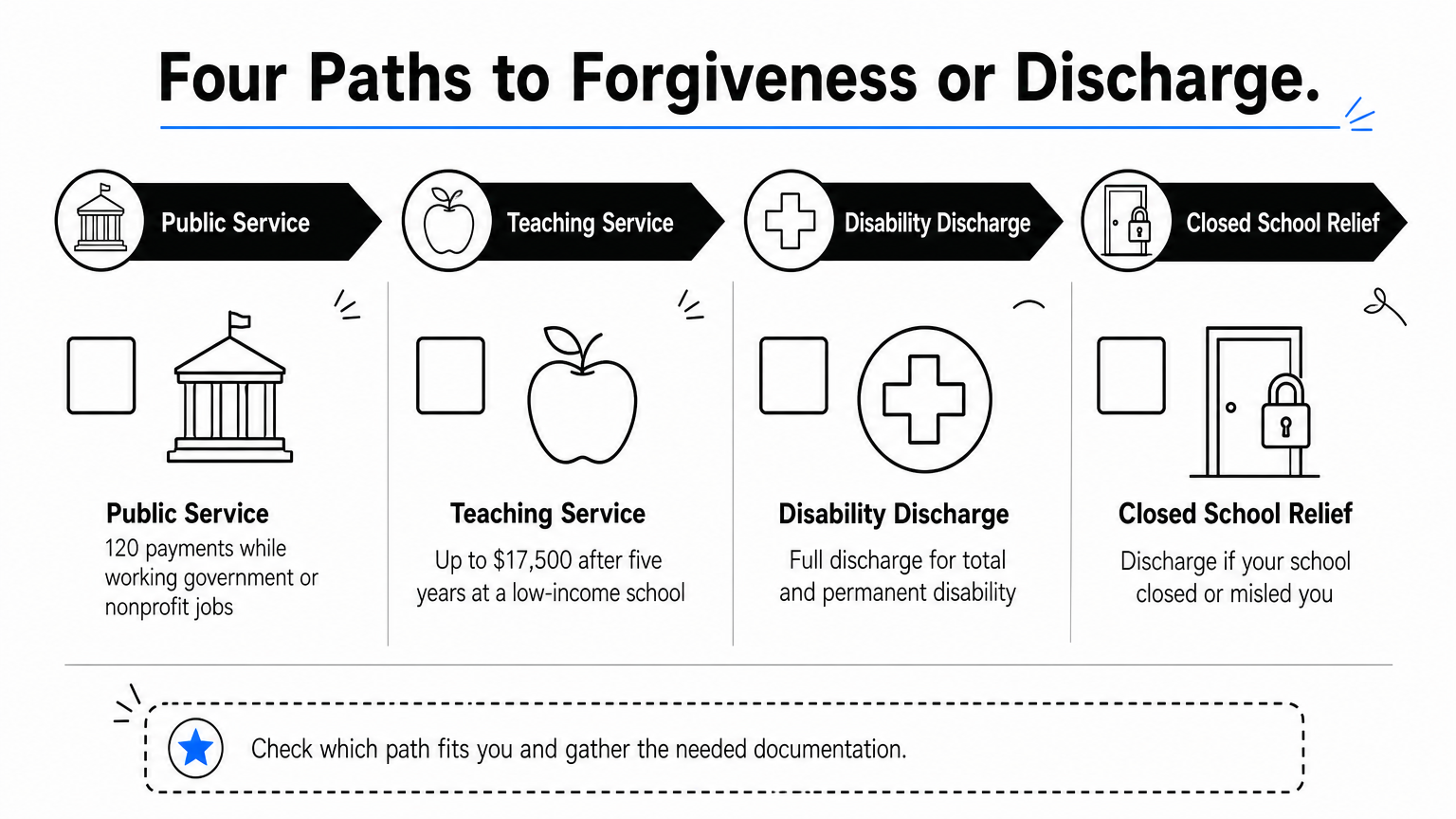
Forgiveness is the only path that erases debt without you paying it off, so rule it out before you rule anything else in.
Checking eligibility takes less than an hour if you know where to look. Run through this list against your own situation:
- Public service work: government, military, or nonprofit employment, tracked via the PSLF Help Tool
- Teaching in a qualifying school: five years at a Title I school or educational service agency
- Total and permanent disability: documented by the VA, SSA, or a physician
- Closed school or borrower defense: your school shut down or misled you about outcomes
Qualifying for none of these doesn’t mean you’re stuck. It just means how to get out of student loan debt shifts from a single cancellation event to a repayment strategy that shrinks your balance over time, which is exactly what the next steps cover.
Step 2. Switch to an income-driven repayment plan
Switching your federal loans to an income-driven repayment plan caps your monthly bill at a percentage of what you actually earn, not what the loan calendar demands. The SAVE plan (formerly REPAYE) sets payments as low as 5% of discretionary income for undergraduate loans, and if your income is low enough, that payment can drop to $0 without triggering default. Anyone asking how do I get out of student loan debt while living paycheck to paycheck should start here, because it’s the single fastest way to lower your monthly outflow without touching your credit, and it follows the same logic as our step-by-step guide to getting out of debt.
A $0 payment on an income-driven plan still counts as a qualifying payment toward forgiveness, so switching costs you nothing and buys you protection.
Before you apply, compare the four federal options so you pick the one that fits your household size and income, not just the first one your servicer suggests:
| Plan | Payment Cap | Forgiveness Timeline |
|---|---|---|
| SAVE | 5-10% of discretionary income | 20-25 years |
| PAYE | 10% of discretionary income | 20 years |
| IBR | 10-15% of discretionary income | 20-25 years |
| ICR | 20% of discretionary income | 25 years |
Applying takes about fifteen minutes through the Federal Student Aid income-driven repayment application, and you’ll need your most recent tax return or pay stubs to verify income. Recertify every year without fail, since a missed recertification can spike your payment back to the standard amount overnight. Once enrolled, any remaining balance after your term is forgiven, though you should budget for potential tax liability on the forgiven amount under current law.
Step 3. Consolidate or refinance to simplify your debt
Consolidating student loans into a single Direct Consolidation Loan simplifies your monthly bills but rarely lowers your interest rate, since the new rate is just a weighted average of what you already had. Refinancing works differently: a private lender pays off your existing loans and issues one new loan, often at a lower rate if your credit and income have improved since graduation. Borrowers asking how to get out of a student loan debt situation involving multiple servicers usually find consolidation useful for organization, while refinancing is the move for actually cutting interest costs.
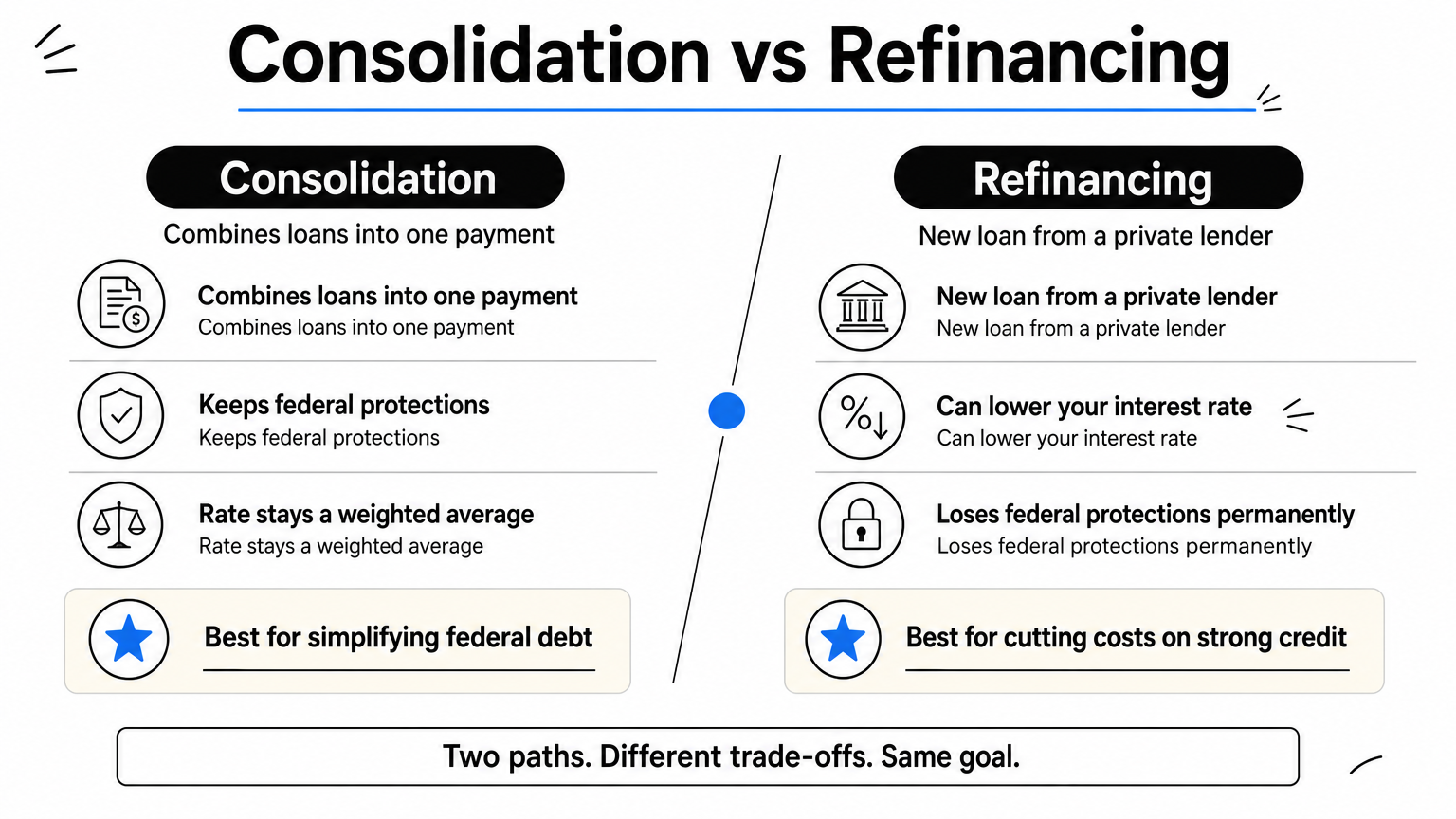
Consolidation organizes your debt, refinancing cuts its cost, and confusing the two can cost you forgiveness eligibility.
Know what you give up
Refinancing federal loans through a private lender permanently strips away income-driven repayment, PSLF eligibility, and deferment options tied to unemployment or hardship. That trade only makes sense once you’ve confirmed forgiveness isn’t on your table. Run through this checklist before you sign anything:
- Confirm PSLF or IDR forgiveness isn’t realistic for your employment situation
- Compare your current rate against refinance offers from at least three lenders
- Check the new term length, since a longer term can lower payments but raise total interest
- Read the fine print on co-signer release and death/disability discharge, which private loans handle far less generously than federal ones
Our guide to how debt consolidation works breaks down how these same tradeoffs apply if you’re also carrying credit card balances alongside your student loans, since combining strategies often saves more than tackling each debt in isolation.
Step 4. Tap employer aid, grants, or settlement as a last resort
Once you’ve exhausted forgiveness, income-driven repayment, and refinancing, a handful of smaller levers can still shrink what you owe. Employer student loan assistance has grown fast since the CARES Act made it tax-free up to $5,250 a year, and companies like Google, Aetna, and PwC now offer it as a standard benefit. Grants and state-specific repayment programs exist too, often tied to working in a shortage field like nursing, teaching, or rural medicine. Anyone still asking how do you get out of student loan debt after trying the earlier steps should treat these as supplemental tools, not primary strategies.
Settlement should be your last move, not your first, because it damages your credit years before it saves you money.
Ask your employer directly
Bring this list to your next HR conversation:
- Confirm whether your employer offers repayment assistance under IRS Section 127
- Check state loan repayment programs tied to your profession or location
- Search Federal Student Aid’s public service database for niche grant programs you may qualify for
Consider settlement only for private loans
Defaulted private loans sometimes qualify for a student loan debt settlement, a lump-sum deal where a lender accepts 40-60% of the balance to close the account. This only works after real default, since lenders rarely negotiate on current loans, and it will hurt your credit score for years. Settling federal loans isn’t an option outside of narrow compromise programs after garnishment, so keep this strategy reserved strictly for private debt where every earlier option has already failed.
Taking your next step toward being debt-free
Getting out of student loan debt isn’t one decision, it’s four sequential checks: forgiveness first, then income-driven repayment, then consolidation or refinance, then the smaller levers like employer aid or settlement. Skipping ahead to refinancing before you’ve ruled out PSLF or income-driven forgiveness is the single most common mistake borrowers make, and it’s often irreversible once you sign with a private lender. Work the steps in order, and you’ll never trade away a benefit you didn’t know you had.
Most readers dealing with student loans are also juggling credit card balances at 18% or higher, and tackling both at once usually beats treating them as separate problems. If that’s your situation, take the next step and see which debt relief program fits your situation and how it can lower your total monthly payment across every debt you’re carrying, not just your loans.