You need a better score fast, maybe for a mortgage rate lock, an apartment application, or a car loan that closes next month. Thirty days feels tight, but it’s enough time to see real movement if you know which levers actually pull fast. That’s exactly what how to raise my credit score in 30 days means in practice: not a slow rebuild, but targeted moves that hit your report before your next statement cuts.
The honest answer is yes, you can raise your score in a month, sometimes by 20 to 50 points, but only by attacking the factors that update quickly. Credit utilization is the biggest one, since it’s recalculated every billing cycle. Errors on your report, old collections, and misreported balances also move fast once disputed correctly.
This guide walks through the specific, sequenced actions that produce measurable results in 30 days: paying down balances at the right time, requesting a credit limit increase, disputing inaccuracies, and using authorized user status strategically. No vague tips, just steps you can start today.
Why your credit score can change in 30 days
Your credit score isn’t a fixed number sitting in a vault somewhere. It’s a snapshot, recalculated every time a lender pulls your file, based on whatever your creditors reported most recently. That’s the entire reason how to raise your credit score in 30 days is a realistic goal instead of wishful thinking. FICO and VantageScore models pull fresh data from your card issuers, usually once per statement cycle, so a balance you pay down today can show up on your report within two to four weeks.
The factors that update on a monthly clock
Not every scoring factor moves at the same speed. Payment history stretches back years and shifts slowly. But credit utilization, the percentage of your available credit you’re using, gets recalculated every single billing cycle. So does your total reported balance. Errors on your credit report can also be corrected within 30 days once you file a dispute, because the Fair Credit Reporting Act gives credit bureaus a strict 30-day window to investigate, per the Consumer Financial Protection Bureau.
| Scoring Factor | Weight in FICO Score | Speed of Change |
|---|---|---|
| Payment history | 35% | Slow (months to years) |
| Credit utilization | 30% | Fast (one billing cycle) |
| Length of credit history | 15% | Slow |
| New credit inquiries | 10% | Fast (immediate hit, fades over months) |
| Credit mix | 10% | Slow |
The fastest score gains come from attacking the 30% of your score that resets every single month: your utilization.
Errors compound this timing advantage. A collection account with the wrong balance, a late payment that was actually on time, or an account that isn’t even yours can drag your score down by 50 to 100 points. Once a bureau removes or corrects that item, the score recalculates almost immediately, sometimes before your next statement even closes. Getting your accurate score back doesn’t require building new credit history from scratch. It requires fixing what’s wrong and paying down what’s high, both of which the scoring models are built to reflect quickly.
Understanding this timing is what separates people who see real movement in a month from people who try random tips, or pay for credit score improvement services, and get frustrated. The next four steps target exactly these fast-moving factors, in the order that produces the biggest score jump for the least effort.
Step 1. Pull your credit reports and spot errors
Start with data, not guesswork. You can’t fix what you can’t see, and roughly one in five consumers has an error on at least one credit report, according to the Federal Trade Commission. Before you touch a single balance, get your hands on all three reports, Equifax, Experian, and TransUnion, because your credit report and credit score differ between bureaus and lenders can pull any one of them.

Where to get your reports for free
Use AnnualCreditReport.com, the only site authorized by federal law to give you free reports from all three bureaus. Skip anything that asks for a credit card number upfront; that’s not the legitimate source.
- Pull all three bureau reports, not just one
- Download or print them so you can mark them up
- Check every account section: open accounts, closed accounts, collections, and public records
- Note the reported balance and credit limit for every revolving account
A single misreported balance can cost you more points than months of on-time payments earn you back.
What actually counts as an error
Grab a highlighter and go line by line. Common errors include accounts that aren’t yours, balances reported higher than what you actually owe, closed accounts still showing as open, duplicate collection entries for the same debt, and late payments on accounts you paid on time. Also watch for outdated credit limits, since a limit reported lower than reality inflates your utilization ratio even if your balance never changed.
Write down every discrepancy with the account name, the specific error, and which bureau reported it. This list becomes your dispute roadmap in Step 2 and the backbone of your credit repair plan, and it’s the single most important document you’ll create in this entire 30-day process.
Step 2. Dispute inaccurate negative items
Once you’ve flagged every error, it’s time to file disputes with each bureau that reported the mistake. The Fair Credit Reporting Act requires bureaus to investigate within 30 days, which lines up almost perfectly with your timeline. File online through each bureau’s dispute portal, since that creates a timestamped record and usually moves faster than mail.
Disputing directly with the bureau works for most people asking how can I raise my credit score in 30 days, but you can also send a dispute letter to the creditor that reported the error. Doing both at once increases your odds of a fast correction, since the creditor has to verify the same information the bureau is questioning.
Every corrected error is a point boost that costs you nothing but paperwork.
What to include in your dispute
Keep the letter factual and specific, and follow a correct credit dispute letter sample if you’re unsure of the format. Vague complaints get rejected; documented ones get corrected.
Date: [today's date]
To: [Bureau name] Dispute Department
Re: Dispute of inaccurate information

Account name: [creditor]
Account number: [last 4 digits]
Error: [balance incorrect / not my account / paid on time, reported late]

I am requesting an investigation under the FCRA and correction
or removal of this inaccurate item within 30 days.

Enclosed: [copy of statement, payment confirmation, etc.]
Send supporting documents like payment confirmations or account statements whenever you have them. Track every dispute you file in a simple spreadsheet with the date, bureau, account, and outcome, since bureaus sometimes miss deadlines and you’ll need proof of when you filed.
Remember that disputes only fix inaccurate negative items, not legitimate ones. A late payment that actually happened won’t disappear just because you dispute it, and filing a false dispute can waste your 30-day window. Focus your energy on documented errors, then move straight to cutting your balances while the disputes process in the background.
Step 3. Pay down credit card balances to cut utilization
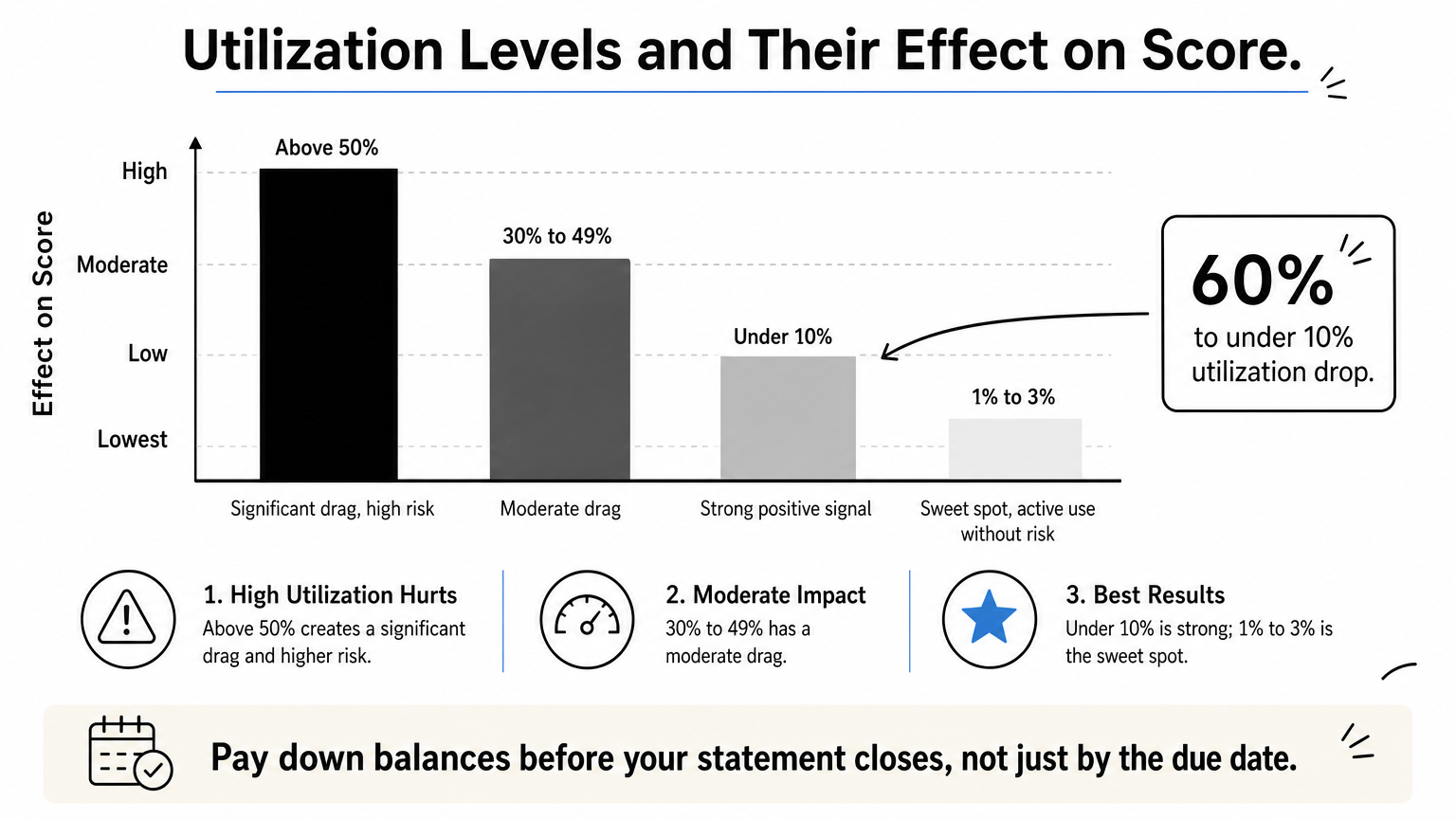
While your disputes work through the system, attack the fastest-moving lever you control directly: credit utilization. This is the ratio of your reported balance to your credit limit, and it makes up 30% of your FICO score. Paying down balances doesn’t just help your wallet, it’s the core mechanic behind how to raise credit score in 30 days, because issuers report your balance once per statement cycle, not in real time.
Target the right number, not just any payment
Scoring models reward specific thresholds, so aim for these targets rather than paying randomly:
| Utilization Level | Effect on Score |
|---|---|
| Above 50% | Significant drag, treated as high risk |
| 30% to 49% | Moderate drag |
| Under 10% | Strong positive signal |
| 1% to 3% | Often the sweet spot, shows active use without risk |
Paying a card down from 60% to under 10% utilization can move your score more in one billing cycle than a year of on-time payments.
Time your payment before the statement closes
Most people pay their bill by the due date, but that’s too late for a 30-day sprint. Instead, pay down the balance a few days before your statement closing date, since that’s the balance the issuer reports to the bureaus. Check your card’s online portal for the exact closing date, then schedule a payment two to three days ahead of it.
Use whatever cash you have to pay off credit card debt fast on the card with the highest individual utilization first, even if another card carries a bigger dollar balance. Requesting a credit limit increase on a card you don’t plan to use heavily also lowers your overall utilization instantly, as long as the issuer doesn’t require a hard inquiry to process it.
Step 4. Add on-time payments and become an authorized user
Boosting your score in the final week means adding positive data, not just removing negative data. Piggybacking as an authorized user on a family member’s old, low-balance credit card is one of the fastest legal ways to inherit years of positive payment history. The account’s age, limit, and clean payment record often get added to your report within one reporting cycle, sometimes lifting a thin file by 20 points or more, a real head start on building your credit score in 6 months.

Choose the right card and cardholder
Ask someone you trust, ideally a parent, spouse, or sibling, whose card meets these criteria before you request to be added:
- Account is at least 5 years old
- Utilization stays under 10%
- Zero late payments in the last 24 months
- Issuer reports authorized users to all three bureaus (most major banks do, but confirm first)
One well-aged authorized user account can add more history to your file than three years of building your own credit.
Report rent and other payments you’re already making
Applying this tactic when you’re wondering how can I raise my credit score in 30 days also means squeezing value from bills you’re already paying. Services like Experian Boost let you add on-time utility and phone payments directly to your Experian file, often within minutes. Rent reporting services work similarly, though they usually take a few days to post. Since these payments don’t carry the risk of new debt, there’s no downside to adding them before your 30 days are up.
Combining a strong authorized user account with reported rent or utility payments gives you two independent boosts working at once, layered on top of the utilization drop from Step 3 and the corrections from Step 2.
Keeping the momentum going past day 30
Thirty days gets you real, measurable gains, but your score doesn’t stop moving just because the calendar does. To maintain good credit, keep your utilization under 10% every month, not just for this sprint, and check your reports quarterly for new errors that creep back in. Fixing what’s inaccurate and paying down what’s high isn’t a one-time trick, it’s the foundation of a durable credit profile.
Staying disciplined about these habits is what separates a temporary bump from lasting progress once you’ve learned how to raise your credit score in 30 days. The authorized user account, the corrected disputes, the lower balances, all of it holds if you keep paying on time and watching your reports.
If you’re still working through balances that feel unmanageable, or you want a clear-eyed comparison of your debt relief options, see how to get out of credit card debt fast before your next statement cuts.